
merchantAccept
Overview
POST /v1/payments/merchantAccept is used in escrow payment scenarios. After the mini-app merchant reviews the customer's order and verifies that the items are in stock and everything is fine (conditions are satisfied, etc.), the merchant may call this OpenAPI to accept the order.
All monetary amounts in requests and responses must be expressed in the smallest currency unit (IQD fils). For example, 100 IQD equals 100000.
- Only payments with escrow product code (
51051000101000100008) can use this API. - The payment must be successfully completed before the merchant can accept.
- Once accepted, the merchant is committed to fulfilling the order.
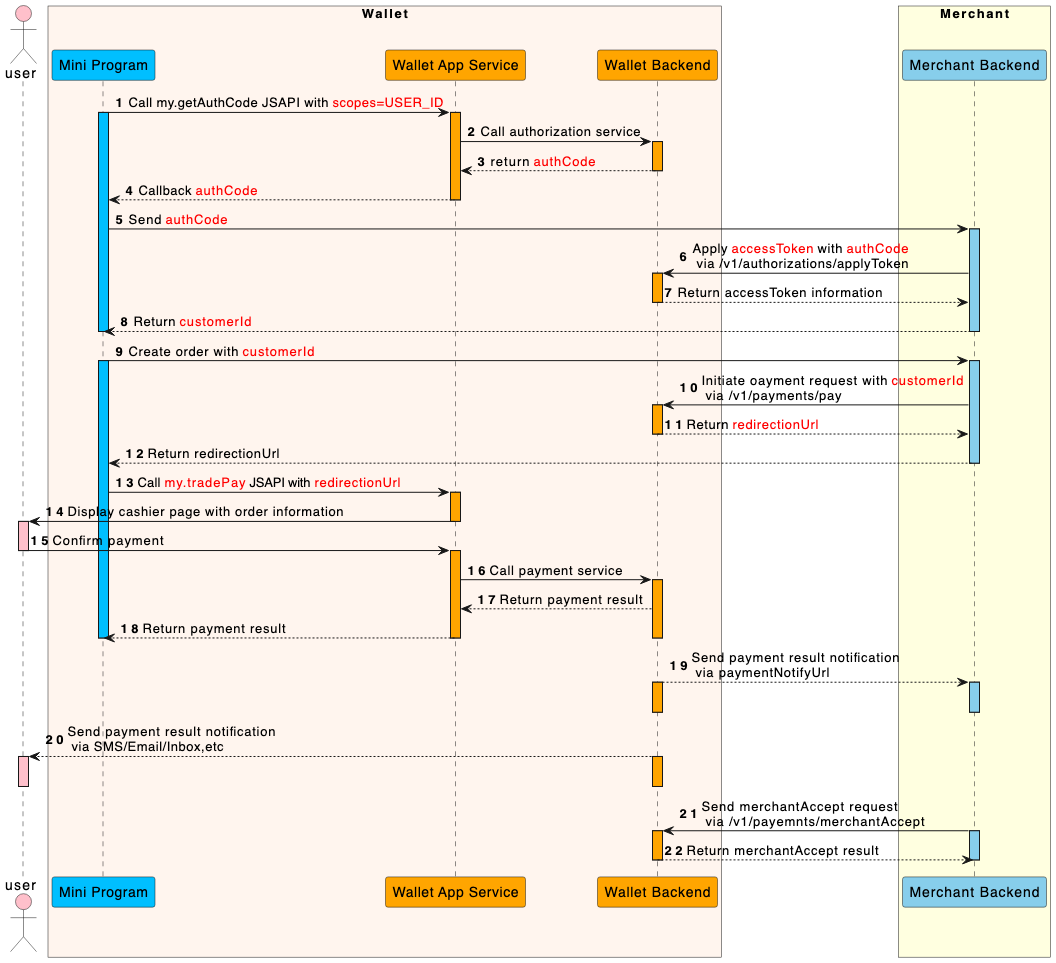
- The Mini Program calls this
my.getAuthCodeJSAPI with specificscopes(USER_ID) to request an authorization code. - The E-wallet App service calls authorization service to processes the authorization information.
- The E-wallet backend verifies the authorization information, generates the
authCodeand returns. - The E-wallet App service returns the
authCodeto the Mini Program. - The Mini Program sends the
authCodeto the merchant backend. - The merchant backend calls the applyToken API with
authCodeto apply theaccessToken. - The E-Wallet backend returns
accessTokeninformation to the merchant backend, such ascustomerId, accessToken, refreshToken, etc. - The merchant backend returns customerId to mini program.
- The Mini Program creates an order with
customerId. - The merchant backend calls the payment API to initiate payment flow, including
customerIdas referenceBuyerId, paymentNotifyUrl(optional), etc. - The E-Wallet backend returns payment detail information the merchant backend, such as
redirectionUrl. - The merchant backend passes the payment detail information to the Mini Program.
- The Mini Program calls the
my.tradePayJSAPI withredirectionUrlto conduct the payment. - The E-Wallet App Service displays the cashier page with order information, such as amount, order details, etc.
- The user confirms the payment in the cashier page.
- The E-Wallet App Service calls payment service and execute the payment process.
- When the payment reaches the final status, the E-wallet backend returns the payment result to the Mini Program (Step 19).
- The E-Wallet App Service returns the payment result to mini program.
- Also the E-wallet backend notifies the merchant backend of the payment result with paymentNotifyUrl provided in Step 10.
- Finally, E-wallet backend notifies the user of the payment result via SMS/Email/Inbox message.
- Merchant backend calls the
merchantAcceptAPI to accept this order. - The E-Wallet backend returns the merchantAccept result to the merchant backend.
Endpoint
| Method | Path |
|---|---|
POST | /v1/payments/merchantAccept |
API Structure
A message consists of a header and body. The following sections are focused on the body structure. For the header structure, see: OpenAPIs Overview.
Request
| Field | Type | Required | Description | Example |
|---|---|---|---|---|
paymentId | string | Yes | The unique ID that is assigned by the wallet to identify a payment. Max. length: 64 characters. | "202312061112128001016" |
Sample Request
{
  "paymentId": "2024071911121280010016601720002644"
}
Response
| Field | Type | Required | Description | Example |
|---|---|---|---|---|
result | object | Yes | The request result, which contains information such as result status and error codes. | { "resultCode": "SUCCESS", "resultStatus": "S", "resultMessage": "Success." } |
Sample Response
{
  "result": {
    "resultCode": "SUCCESS",
    "resultStatus": "S",
    "resultMessage": "Success."
  }
}
Result Process Logic
In the response, the result.resultStatus field indicates the result of processing a request. The following table describes each result status:
| resultStatus | Description |
|---|---|
S | It means that the merchant accept is successful. The corresponding result.resultCode is "SUCCESS", and the result.resultMessage is "Success.". |
U | It means that the status of the merchant accept result is unknown. The corresponding result.resultCode is UNKNOWN_EXCEPTION, and result.resultMessage is "An API calling is failed, which is caused by unknown reasons". For details, see the Common error codes section. |
F | It means that the merchant accept fails. The corresponding result.resultCode and result.resultMessage may vary based on different situations. For details, see the Error codes section. |
Error Codes
Error codes are usually classified into the following categories:
- Common error codes are common across all mini program's APIs.
- API-specific error codes are listed in the following table.
| resultStatus | resultCode | resultMessage |
|---|---|---|
F | ORDER_UNSUPPORTED_OPERATION | The order not supported the operation. |
F | ORDER_STATUS_INVALID | The order status is invalid. |
F | ORDER_NOT_EXIST | The order does not exist. |
F | ORDER_IS_FROZEN | The order is frozen. |
F | ORDER_IS_MERCHANT_ACCEPTED | The order has been accepted by merchant. |
F | CURRENCY_NOT_SUPPORT | The currency of a user's payment is not supported by the merchant. |
F | USER_NOT_EXIST | The user does not exist. |
F | USER_STATUS_ABNORMAL | The user status is abnormal. |
F | PARTNER_NOT_EXIST | The partner does not exist. |
F | PARTNER_STATUS_ABNORMAL | The partner status is abnormal. |