
sendPush
Overview
POST /v1/messages/sendPush enables merchants or Independent Software Vendors (ISV) to send push messages to wallet users using access tokens. This API allows you to deliver push notifications, alerts, and other time-sensitive messages directly to users' devices.
The message content is customizable through templates, allowing you to include dynamic parameters such as titles, content text, and deep links to specific pages within your Mini Program.
- Ensure the access token has the
NOTIFICATION_PUSHscope before attempting to send messages. - The
requestIdis idempotent—submitting the same ID multiple times will only send the message once. - Verify the access token is valid and not expired before making the API call.
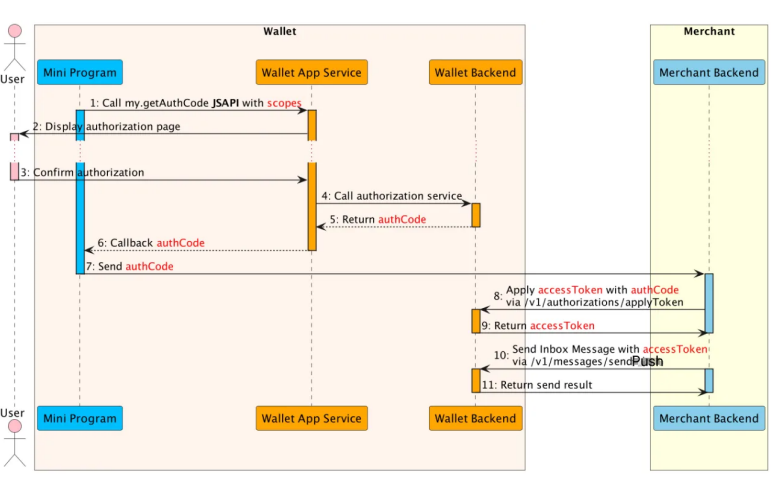
- The Mini Program calls the
my.getAuthCodeJSAPI with specific scopes(NOTIFICATION_PUSH) to request an authorization code. - The E-wallet App processes the request and displays the authorization page that needs to be authorized.
- The user confirms the authorization in the super app.
- The E-wallet App service calls authorization service to processes the authorization information.
- The E-wallet backend verifies the authorization information, generates the
authCodeand returns. - The E-wallet App service returns the
authCodeto the Mini Program. - The Mini Program sends the
authCodeto the merchant backend. - The merchant backend calls the
applyTokenAPI withauthCodeto apply theaccessToken. - The E-wallet backend returns
accessTokeninformation to the merchant backend, such as accessToken, refreshToken, etc. - The merchant backend calls this API with the
accessTokento send push message to the user. - The E-wallet backend returns the send result, including
messageId.
Endpoint
| Method | Path |
|---|---|
POST | /v1/messages/sendPush |
API Structure
A message consists of a header and body. The following sections are focused on the body structure. For the header structure, see:
- Request header
- Response header
Request
| Field | Type | Required | Description | Example |
|---|---|---|---|---|
accessToken | string | Yes | Access token used to send push messages. Obtain via applyToken with NOTIFICATION_PUSH scope. Max length 128 characters. | "2019112719074101000700000077771xxxx" |
requestId | string | Yes | Unique request identifier for idempotency. Resubmitting the same requestId will not send duplicate messages—if the same requestId is stored, the stored result is returned. Max length 128 characters. | "20191127190741010007013213123xxxx" |
templateCode | string | Yes | Unique code to distinguish different content templates. Max length 256 characters. | "MINI_APP_COMMON_PUSH" |
templates | array | Yes | Array of content template objects for push messages. The URL is generated by the mini program platform. Each object contains templateParameters with Title, Content, and Url fields. | See structure below |
Template Structure:
Each item in the templates array must include:
templateParameters.Title(string, required): The push message titletemplateParameters.Content(string, required): The push message content/bodytemplateParameters.Url(string, required): Deep link URL to navigate within the Mini Program (format:mini://platformapi/startapp?_ariver_appid={appId})
{
  "accessToken": "2019112719074101000700000077771xxxx",
  "requestId": "20191127190741010007013213123xxxx",
  "templateCode": "MINI_APP_COMMON_PUSH",
  "templates": [
    {
      "templateParameters": {
        "Title": "mini-push-title",
        "Content": "hello mini program",
        "Url": "mini://platformapi/startapp?_ariver_appid=888888"
      }
    }
  ]
}
Response
| Field | Type | Required | Description | Example |
|---|---|---|---|---|
result | object | Yes | Request result containing status and error codes information. | { "resultCode": "SUCCESS", "resultStatus": "S", "resultMessage": "success" } |
messageId | string | No | Unique message identifier. Present when message is sent successfully. Max length 258 characters. | "20201235900212xxxx" |
extendInfo | string | No | Additional extensive information. Max length 4096 characters. | "This is additional information" |
{
  "messageId": "20201235900212xxxx",
  "extendInfo": "",
  "result": {
    "resultCode": "SUCCESS",
    "resultStatus": "S",
    "resultMessage": "success"
  }
}
Result Processing Logic
The result.resultStatus field indicates the result of processing a request as follows:
| Status | Description |
|---|---|
S | Request succeeded. Sending push messages via access tokens is successful. resultCode is SUCCESS and resultMessage is success. |
A | Request accepted. The request is accepted by wallets. resultCode is ACCEPT; resultMessage varies based on different situations. |
U | Outcome unknown. Unknown exception occurred on wallet side. The merchant or ISV may try again. resultCode is UNKNOWN_EXCEPTION and resultMessage is "An API calling is failed, which is caused by unknown reasons." |
F | Request failed. Sending push messages via access tokens fails. Inspect resultCode and resultMessage which vary based on different situations. Cross-reference Error codes below. |
Error Codes
API-specific error codes: are listed in the following table.
| Error Code | Result Status | Message | Next Step |
|---|---|---|---|
ACCESS_TOKEN_NOT_COVER_THE_SCOPE | F | The access token permission scope does not contain specified scope. | Check the permission for the access token and try again. Ensure the access token includes the NOTIFICATION_PUSH scope. |
INVALID_ACCESS_TOKEN | F | The access token is invalid. | Restart the OAuth again or refresh the token and try again. |
PARAM_ILLEGAL | F | Illegal parameters exist. For example, a non-numeric input, or an invalid date. | Check the templates content and try again. |
UNKNOWN_EXCEPTION | U | An API calling is failed, which is caused by unknown reasons. | 1. Check whether templateCode is MINI_APP_COMMON_PUSH. If it is not MINI_APP_COMMON_PUSH, modify it.2. Check whether the templateCode value in the request parameter meets the document expectations. |