
confirm
Overview
POST /v1/payments/confirm is used to capture the total authorized payment amount from a user's account, and then transfer the total amount of the payment to a merchant's account after the user confirms receipt. The confirm can only be initiated once and in full.
Note: The merchant may call the confirm API to notify A+ that the order has been confirmed only after the customer has actually completed the order confirmation.
All monetary amounts in requests and responses must be expressed in the smallest currency unit (IQD fils). For example, 100 IQD equals 100000.
- Only payments with escrow product code (
51051000101000100008) can use this API. - The merchant must have already accepted the payment using
merchantAcceptbefore the customer can confirm. - Once confirmed, funds are immediately released to the merchant and cannot be reversed.
- Customers should only confirm after verifying the goods are satisfactory.
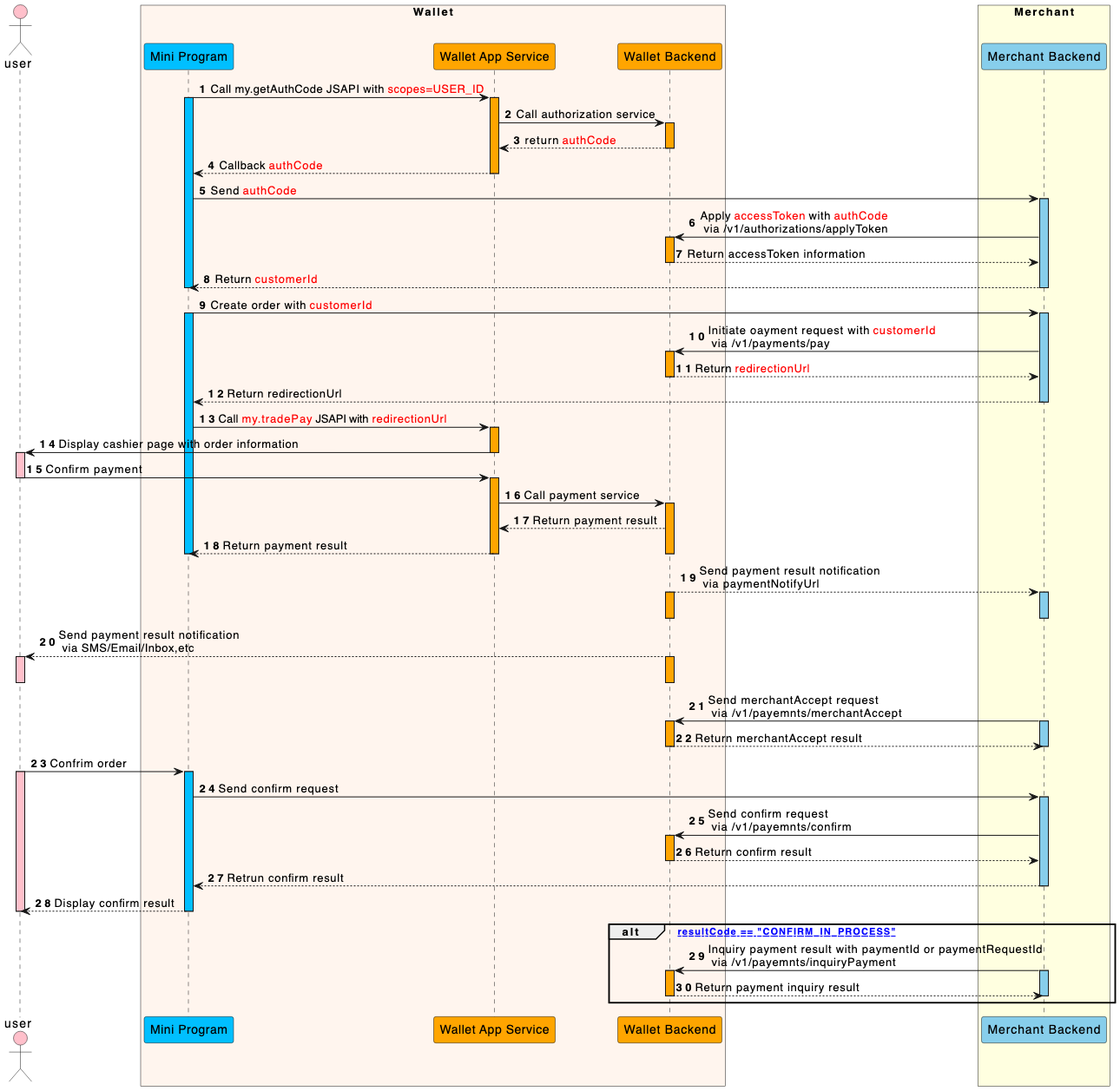
- The Mini Program calls this
my.getAuthCodeJSAPI with specificscopes(USER_ID) to request an authorization code. - The E-wallet App service calls authorization service to processes the authorization information.
- The E-wallet backend verifies the authorization information, generates the
authCodeand returns. - The E-wallet App service returns the
authCodeto the Mini Program. - The Mini Program sends the
authCodeto the merchant backend. - The merchant backend calls the applyToken API with
authCodeto apply theaccessToken. - The E-Wallet backend returns
accessTokeninformation to the merchant backend, such ascustomerId, accessToken, refreshToken, etc. - The merchant backend returns customerId to mini program.
- The Mini Program creates an order with
customerId. - The merchant backend calls the payment API to initiate payment flow, including
customerIdas referenceBuyerId, paymentNotifyUrl(optional), etc. - The E-Wallet backend returns payment detail information the merchant backend, such as
redirectionUrl. - The merchant backend passes the payment detail information to the Mini Program.
- The Mini Program calls the
my.tradePayJSAPI withredirectionUrlto conduct the payment. - The E-Wallet App Service displays the cashier page with order information, such as amount, order details, etc.
- The user confirms the payment in the cashier page.
- The E-Wallet App Service calls payment service and execute the payment process.
- When the payment reaches the final status, the E-wallet backend returns the payment result to the Mini Program (Step 19).
- The E-Wallet App Service returns the payment result to mini program.
- Also the E-wallet backend notifies the merchant backend of the payment result with paymentNotifyUrl provided in Step 10.
- Finally, E-wallet backend notifies the user of the payment result via SMS/Email/Inbox message.
- Merchant backend calls the
merchantAcceptAPI to accept this order. - The E-Wallet backend returns the merchantAccept result to the merchant backend.
- The Mini Program sends the confirm request to merchant backend, and the merchant backend calls the
confirmAPI to capture the money(Step 25). - (This step is internal - see step 25)
- Send confirm request via
/v1/payments/confirm. - The E-Wallet backend returns the confirm result to the merchant backend.
- The merchant backend returns confirm result.
- And the Mini Program displays the confirm result to the user(Step 28).
Alternative flow:
When the E-Wallet backend returns the resultCode as CONFIRM_IN_PROCESS, the merchant can call inquiryPayment API to query confirm result (Step 29).
Endpoint
| Method | Path |
|---|---|
POST | /v1/payments/confirm |
API Structure
A message consists of a header and body. The following sections are focused on the body structure. For the header structure, see: OpenAPIs Overview.
Request
| Field | Type | Required | Description | Example |
|---|---|---|---|---|
paymentId | string | Yes | The unique ID that is assigned by the wallet to identify a payment. Max. length: 64 characters. | "202312061112128001016" |
confirmRequestId | string | Yes | The unique ID is assigned by a merchant to identify a confirm request. Max. length: 64 characters. | "1022188000000000001xxxx" |
extendInfo | string | No | The extension information that wallets and merchants want to describe. The format should be JSON format. Max. length: 2048 characters. | - |
Sample Request
{
  "paymentId": "202312061112128001001660090000xxxx",
  "confirmRequestId": "1022188000000000001xxxx"
}
The
confirmRequestIdis used for idempotence—repeat submissions with the same ID will yield the same final result.
Response
| Field | Type | Required | Description | Example |
|---|---|---|---|---|
result | object | Yes | The request result, which contains information such as result status and error codes. | { "resultCode": "SUCCESS", "resultStatus": "S", "resultMessage": "Success." } |
confirmId | string | No | The unique ID for a confirm request generated by the wallet. Max. length: 64 characters. | "202312061112128001016x" |
confirmTime | string | No | The processing time for a confirm request. The format of the value follows the ISO 8601 standard. | "2025-07-08T12:12:12+08:00" |
Sample Response
{
  "result": {
    "resultCode": "SUCCESS",
    "resultStatus": "S",
    "resultMessage": "Success."
  },
  "confirmId": "202312061112128001016x",
  "confirmTime": "2025-07-08T12:12:12+08:00"
}
Result Process Logic
In the response, the result.resultStatus field indicates the result of processing a request. The following table describes each result status:
| resultStatus | Description |
|---|---|
S | It means that the confirm is successful. The corresponding result.resultCode is "SUCCESS", and the result.resultMessage is "Success.". |
U | It means that the status of the confirm result is unknown. The corresponding result.resultCode is UNKNOWN_EXCEPTION, and result.resultMessage is "An API calling is failed, which is caused by unknown reasons". For details, see the Common error codes section. |
F | It means that the confirm fails. The corresponding result.resultCode and result.resultMessage may vary based on different situations. For details, see the Error codes section. |
Error Codes
Error codes are usually classified into the following categories:
- Common error codes are common across all mini program's APIs.
- API-specific error codes are listed in the following table.
| resultStatus | resultCode | resultMessage |
|---|---|---|
F | ORDER_UNSUPPORTED_OPERATION | The order is not support capture. |
F | ORDER_STATUS_INVALID | The order status is invalid. |
F | ORDER_NOT_EXIST | The order does not exist. |
U | CONFIRM_IN_PROCESS | The confirm is processing. |
F | CURRENCY_NOT_SUPPORT | The currency of a user's payment is not supported by the merchant. |
F | USER_NOT_EXIST | The user does not exist. |
F | USER_STATUS_ABNORMAL | The user status is abnormal. |
F | REPEAT_REQ_INCONSISTENT | The submitted request is not consistent with the repeated one. |
F | MUTEX_OPERATION_IN_PROCESSING | There is another payment void, confirm, or capture in processing. |
F | PARTNER_NOT_EXIST | The partner does not exist. |
F | PARTNER_STATUS_ABNORMAL | The partner status is abnormal. |
Related Links
- pay (Use product code
51051000101000100008for escrow) - merchantAccept
- void
- inquiryPayment